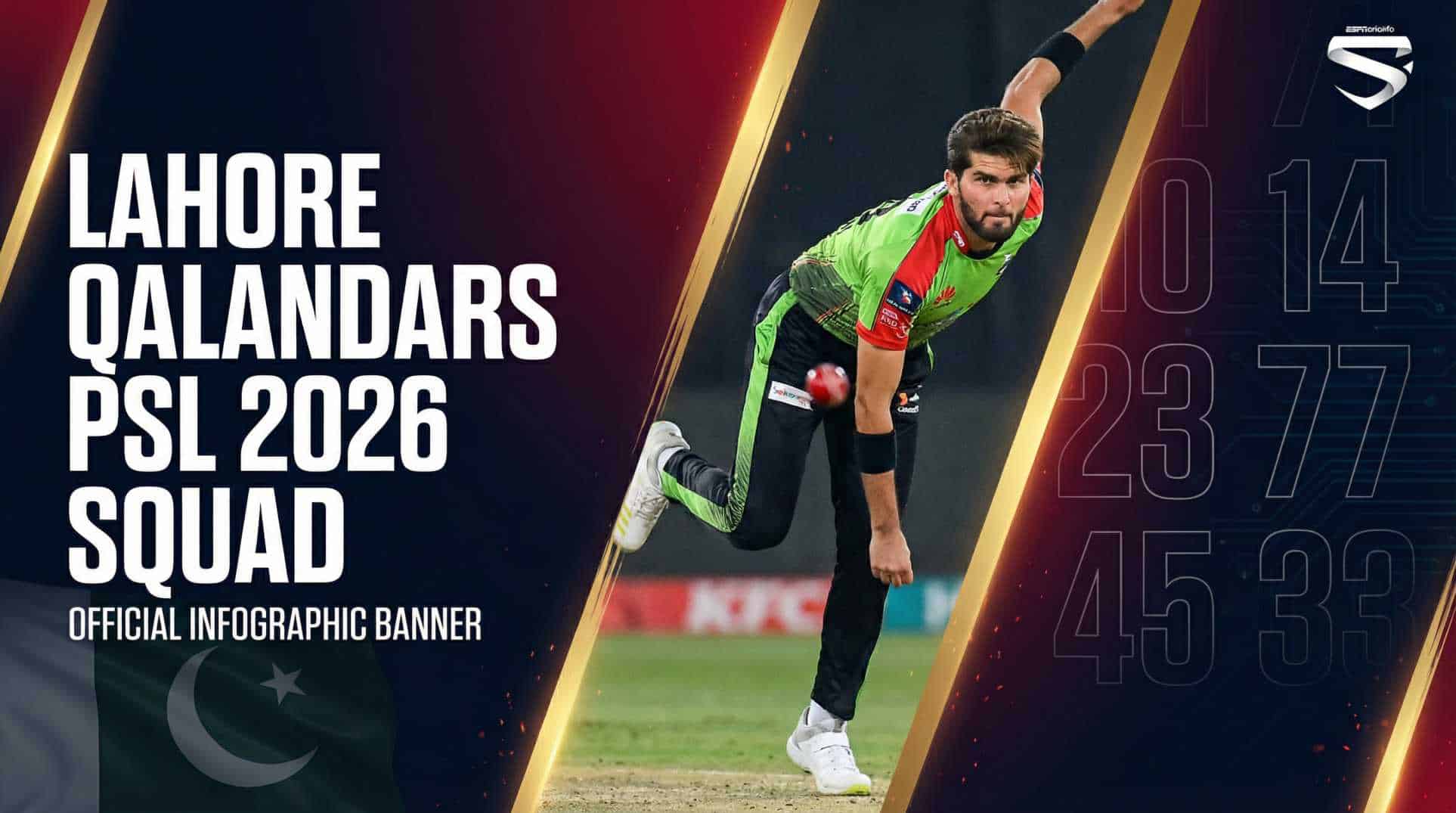
Full Lahore Qalandars PSL 2026 squad breakdown — retention drama, the Haris Rauf release-and-rebuy, the Wellalage swap, and likely XI combinations.
Key Takeaways
- Lahore released Haris Rauf before the auction, then paid PKR 7.6 crore to buy him back — a calculated gamble tied to how the retention budget and slots were structured.
- Late-tournament turbulence hit the spin department when Gudakesh Motie withdrew after being stranded following the T20 World Cup, with Sri Lanka’s Dunith Wellalage signed as a direct replacement.
- The squad carries five overseas contenders for four playing slots, meaning Lahore’s management faces a genuine rotation puzzle across the group stage and playoffs.
- Fakhar Zaman’s powerplay form and Shaheen Shah Afridi’s fitness across a longer, 10-match group stage are the two factors most likely to decide Lahore’s season.
Lahore Qalandars open PSL 2026 as defending champions, hosting new franchise Hyderabad Kingsmen at Gaddafi Stadium on March 26 — the tournament’s opening fixture. But the real story behind this squad isn’t just who Lahore signed. It’s the sequence of decisions that got them there: a retention gamble on Haris Rauf that could easily have backfired, a late injury-forced swap in the spin department, and a squad genuinely deep enough to field three or four different winning combinations depending on conditions. Here’s the full picture, position by position.
The Full Confirmed Squad
Lahore’s PSL 11 roster blends four retained players, one direct signing, ten auction purchases, and a late replacement addition:
Shaheen Shah Afridi (captain, retained, PKR 7 crore), Abdullah Shafique (retained, PKR 2.20 crore), Sikandar Raza (retained, PKR 2.80 crore), Mohammad Naeem (retained, PKR 70 lakh), Mustafizur Rahman (direct signing, PKR 6.44 crore), Fakhar Zaman (auction, PKR 7.95 crore), Haris Rauf (auction, PKR 7.60 crore), Usama Mir (auction, PKR 3.50 crore), Ubaid Shah (auction, PKR 2.70 crore), Haseebullah Khan (auction, PKR 1.10 crore), Mohammad Farooq (auction, PKR 60 lakh), Dasun Shanaka (auction, PKR 75 lakh), Parvez Hossain Emon (auction, PKR 60 lakh), Asif Ali (auction, PKR 60 lakh), Tayyab Tahir (auction, PKR 60 lakh), and Dunith Wellalage, signed as a direct replacement after Gudakesh Motie’s withdrawal.
Why Lahore’s Retention Strategy Tells a Bigger Story
Lahore had four retention slots and used them with clear intent. Keeping Shaheen Shah Afridi as the Platinum retention was never really a decision to debate — he’s the captain, the best bowler on the roster, and the one player capable of turning a match on his own. Abdullah Shafique’s Diamond-category retention made similar sense, given how much stability he provides at the top when everyone else around him is swinging freely.
The more interesting calls were Sikandar Raza at Gold and Mohammad Naeem at Silver. Raza remains one of the smartest all-round cricketers in this squad — he reads situations well, contributes meaningfully with both bat and ball, and rarely looks uncomfortable regardless of match context. Naeem, meanwhile, had a breakout PSL 10, good enough to earn the tournament’s Emerging Player award, and both retentions look like strong value at their respective price points.
The Haris Rauf Gamble
This is the part of Lahore’s squad-building that most previews skip entirely. Rauf — central to Lahore’s title wins in 2022, 2023, and 2025 — was not among the four retained players heading into the auction. He was let go, despite years of being one of the franchise’s most important bowlers.
Then, on the auction floor, Lahore paid PKR 7.6 crore to buy him back — more than his retention fee would likely have cost them. The logic here comes down to how the retention rules and budget structure worked: freeing up that slot for a cheaper retained player (Naeem) and then competing for Rauf in the open market was, on paper, the more cost-efficient route. It worked out for Lahore, but it genuinely could have gone the other way. If a rival franchise had pushed the bidding further, Lahore risked losing one of its most important bowlers entirely over a budgeting decision.
Fakhar Zaman’s Return Wasn’t Optional Either
Fakhar Zaman, the franchise’s all-time leading run-scorer, went through a similar path — unretained, then bought back at auction for PKR 7.95 crore, the highest fee Lahore paid for any player this season. That price alone signals how essential he is to the top order. There was realistically no version of this squad that worked without him anchoring the powerplay.
Mustafizur Rahman as the Direct Signing
Before the auction opened, Lahore used their one direct-signing slot on Bangladesh’s Mustafizur Rahman, committing PKR 6.44 crore to a bowler who isn’t always available across every major franchise league globally. His cutters and slower-ball variations give Shaheen a genuine death-overs partner, which matters specifically on Gaddafi Stadium’s slower surfaces where raw pace alone doesn’t always translate to control.
The Late Twist: Motie Out, Wellalage In
Just days before the tournament began, Lahore’s spin plans were disrupted. Gudakesh Motie, the West Indies left-arm spinner originally signed for the squad, withdrew from PSL 2026 after West Indies’ squad was stranded in Kolkata following elimination from the T20 World Cup on March 1 — airspace restrictions across West Asia left the team unable to secure flights home in time, and Motie ultimately chose not to travel on to Pakistan.
Lahore moved quickly, confirming Sri Lanka’s Dunith Wellalage as a direct replacement. Wellalage, only 23, had an impressive recent World Cup campaign — 8 wickets at an economy of 7.22, noticeably tighter than Motie’s own 7.86 across the tournament. He now joins his national captain Dasun Shanaka at Lahore, giving the squad a Sri Lankan pairing that already understands each other’s game inside a dressing room. Based on the raw numbers alone, this swap could genuinely work out in Lahore’s favor rather than being a step down.
Batting Depth: Layered Rather Than Top-Heavy
Fakhar Zaman opens without debate, tasked with attacking the powerplay and setting the tone. Mohammad Naeem is the likely partner, aggressive enough to match Fakhar’s tempo while still capable of rotating strike when the situation calls for it. Abdullah Shafique follows at three as the innings’ anchor — not the most eye-catching role, but valuable across a long tournament where someone needs to hold an innings together through a rough patch.
The middle order leans on Sikandar Raza’s all-round value, supported by Dasun Shanaka’s aggressive Sri Lankan hitting and medium-pace flexibility. Asif Ali slots in as the dedicated finisher — the batter Lahore wants at the crease if 40 runs are needed off 18 balls — while Tayyab Tahir and Parvez Hossain Emon provide further middle-order cover, including a genuine left-handed option in Emon. Haseebullah Khan rounds things out as a keeper-batter capable of contributing at the top or lower down, which matters in a tournament structure where a quick-scoring number seven can change a match’s final few overs.
Bowling Depth: Genuinely More Balanced Than It Looks
Lahore’s top three seamers — Shaheen, Rauf, and Mustafizur — form as strong a pace trio as any side fields in PSL 2026. Shaheen bowls both ends of the innings and leads the tactical thinking from ball one; Rauf remains one of the hardest bowlers in world T20 cricket to face at the death, with his yorkers regularly clocking 145–150 km/h; and Mustafizur’s cutters give Lahore a different kind of control that neither Pakistani quick offers in quite the same way. Ubaid Shah adds a genuine fourth seam option with raw pace, while Mohammad Farooq provides lower-order batting utility alongside occasional medium pace.
The spin department deserves more credit than it usually gets in outside coverage of this squad. Sikandar Raza offers senior off-break control, Usama Mir brings genuine leg-spin wicket-taking threat at a well-priced PKR 3.5 crore, and Dunith Wellalage adds left-arm orthodox variety along with useful lower-order batting. Between the three, Lahore can field off-break, leg-break, and left-arm spin options depending entirely on what a given surface demands — a level of variety very few T20 squads can genuinely claim.
The Playing XI Puzzle
Lahore’s most likely starting XI on a typical surface reads: Fakhar Zaman, Mohammad Naeem, Abdullah Shafique, Sikandar Raza, Dasun Shanaka, Asif Ali, Haseebullah Khan (wicketkeeper), Shaheen Shah Afridi (captain), Mustafizur Rahman, Haris Rauf, and one of Usama Mir or Dunith Wellalage.
On surfaces expected to turn, Wellalage likely comes in for either Ubaid Shah or one of the frontline seamers. On flatter, high-scoring tracks, Tayyab Tahir or Parvez Emon can slot into the middle order, pushing Raza to bowl a larger share of overs. That flexibility — three or four genuinely different valid XIs depending on conditions — is exactly what a squad needs across 10 group matches plus a playoff run.
What Most Squad Previews Still Miss
Two things rarely get discussed with enough depth. First, the overseas quota challenge: Lahore has five genuine overseas contenders — Mustafizur, Sikandar Raza, Dasun Shanaka, Parvez Emon, and Dunith Wellalage — competing for four playing slots. Balancing Raza and Shanaka’s all-round value against Mustafizur and Wellalage’s specialist bowling skills will be a real tactical decision match by match, not a settled rotation.
Second, PSL 2026’s expanded structure changes squad management itself. Ten group-stage matches across six venues is a heavier workload than previous seasons, which puts genuine pressure on managing Shaheen and Rauf’s bowling loads while keeping fringe players like Ubaid Shah and Mohammad Farooq match-fit and ready. Depth isn’t a luxury for this squad this season — it’s a structural requirement.
The Questions That Will Actually Decide Lahore’s Season
Shaheen’s fitness across a longer tournament matters more than any single signing. He remains the squad’s most important player by a clear distance, and if he suffers a mid-tournament injury, neither Ubaid Shah nor Mohammad Farooq offers a comparable replacement. Fakhar Zaman’s powerplay form is nearly as decisive — Lahore’s innings tend to follow his opening six overs closely, and when he doesn’t fire, the innings has historically struggled to recover fully.
Usama Mir’s consistency is the squad’s genuine swing factor. Leg-spinners in T20 cricket tend to be either match-winners or liabilities with little middle ground, and if he’s tight in length while mixing his googly effectively, Lahore gains a sixth bowling option no opponent wants to face. And Dunith Wellalage, arriving fresh off a long international tournament into an entirely new franchise environment, still has to prove he can settle quickly at 23 years old.
Lahore’s biggest structural advantage over the rest of the field remains squad depth — most PSL sides have four or five genuine match-winners before a noticeable drop-off, while Lahore’s positions seven through eleven can still contribute runs and wickets that matter. Across a longer tournament with back-to-back fixtures, that kind of depth tends to compound rather than stay static.
FAQs: Lahore Qalandars PSL 2026 Squad
Why didn’t Lahore retain Haris Rauf before the auction? Retention rules and budget constraints made it more efficient for Lahore to retain a cheaper player in that slot and compete for Rauf separately at auction, where they paid PKR 7.6 crore to bring him back.
Who replaced Gudakesh Motie in Lahore’s squad? Sri Lanka’s Dunith Wellalage was signed as a direct replacement after Motie withdrew due to travel disruptions following his elimination at the T20 World Cup.
What is Lahore Qalandars’ opening match in PSL 2026? Lahore hosts Hyderabad Kingsmen at Gaddafi Stadium on March 26, 2026, the tournament’s opening fixture.
How many overseas players are competing for spots in Lahore’s XI? Five overseas players — Mustafizur Rahman, Sikandar Raza, Dasun Shanaka, Parvez Hossain Emon, and Dunith Wellalage — are competing for four available slots in the playing XI.
For a look at how the league’s newest franchise stacks up against Lahore’s own squad depth, check out our full Pindiz PSL 2026 squad breakdown. Official retention and auction data can be cross-checked via ESPNcricinfo and Geo Super. Which Lahore combination do you think takes the field most often this season — share your XI in the comments.
Season Update:
Lahore Qalandars — How Their PSL 11 Season Went
This wasn’t the season Lahore’s fans were hoping for. As defending champions, finishing fifth and missing the playoffs entirely was always going to be a hard result to take. They won exactly half their matches — five from ten — but a negative net run rate of −0.482 left them just short of Hyderabad Kingsmen for the final playoff spot. Shaheen Shah Afridi’s bowling was a consistent bright spot, but the batting never found the rhythm needed to turn close losses into the kind of big wins that protect your NRR.